Are the Boston Celtics Still Built for a Championship – and What Do Today’s Betting Odds Really Say?
For years, the Boston Celtics felt perpetually on the brink of greatness. That familiar storyline has changed, but not in the way Celtics fans once hoped



For years, the Boston Celtics felt perpetually on the brink of greatness: elite talent, deep rotations, soaring expectations, and then a cold shooting night, a turnover spree, or an untimely injury. That familiar storyline has changed, but not in the way Celtics fans once hoped. This season (2025–26), Boston looks less like a juggernaut and more like a proud contender in transition.
There’s no Jayson Tatum – he’s rehabbing a torn Achilles and is widely expected to miss the year – and Kristaps Porziņģis is no longer spacing the floor at TD Garden; he’s in Atlanta after a summer of seismic moves. Add in a market that now prices Boston closer to dark-horse status than favorite, and you have a very different Celtics conversation than even a year ago.
A Summer That Redefined the Core
Boston’s offseason was headlined by two franchise-shaping decisions. First, the Celtics sent Kristaps Porziņģis to the Hawks in a three-team deal with Atlanta and Brooklyn, finalized in early July. As part of that trade, Boston brought in Georges Niang, while the Nets received Terance Mann and the draft rights to Drake Powell.
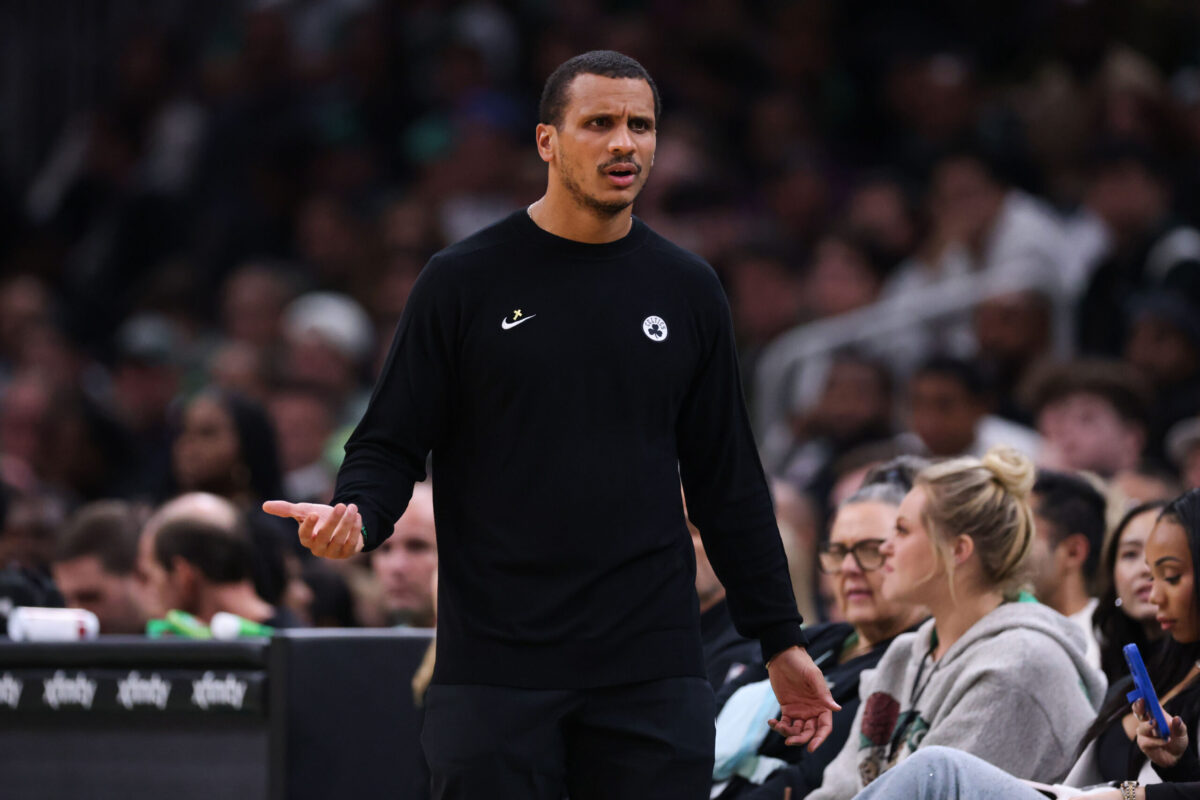
For bettors tracking futures the way an online casino updates its odds board, the move effectively ended Porziņģis’ short but impactful Boston stint and removed one of the league’s most dangerous five-out shooting threats from Joe Mazzulla’s playbook.
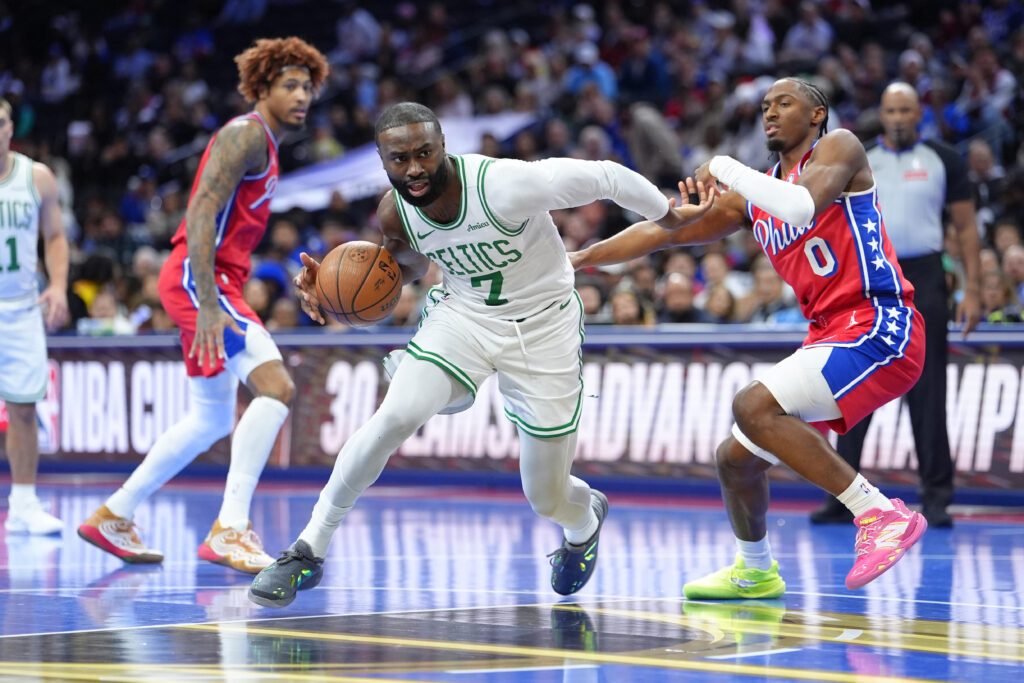
Second, Boston retooled its backcourt by trading Jrue Holiday to Portland for Anfernee Simons (draft capital terms were subsequently amended as the deal became official). Simons arrives as a downhill, shot-creating guard on an expiring deal – useful on the floor and useful on the balance sheet. Multiple outlets in Boston and nationally have detailed both the basketball fit and the cap implications of the swap.
Layered on top of those choices is the single most consequential development of all: Jayson Tatum’s Achilles tear suffered during last spring’s playoffs. Standard recovery timelines and current reporting point to him missing the entire 2025–26 season, even as Tatum himself has remained publicly hopeful. In practical terms, Boston has been forced to recalibrate its offense and identity without its MVP-caliber hub.
There was also a tectonic change off the court: the NBA approved (and Boston later finalized) the sale of the franchise to a group led by Bill Chisholm at a record valuation, with Chisholm taking control and Wyc Grousbeck’s era officially ending. While ownership does not win pick-and-rolls, the sale underscores that this is a new chapter structurally as well as on the roster.
What the Team Actually Looks Like Now
Strip away the nostalgia for last year’s title-caliber machine, and you’ll find a club built around Jaylen Brown, Derrick White, and the newly arrived Anfernee Simons, with role definition still settling. Without Porziņģis stretching to 30 feet and Tatum warping defenses, Boston’s spacing is more conventional, and the half-court offense leans more on guard creation and movement shooting from players like Sam Hauser.
The center rotation has been more by committee – Neemias Queta’s size and energy have been useful – and Joe Mazzulla has leaned into lineups that prioritize pace and dribble penetration. Depth-chart snapshots reflect a group in flux, and early-season usage has matched that reality.
Through games of November 6, the Celtics were 4–5 and sitting 10th in the East – squarely in the early play-in mix rather than in the pole position they’ve grown used to. The margin data is middling (positive differential, but not dominant), and the standings table tells the story plainly: Boston is clawing rather than cruising.
The Real Reason This Year Feels Different
A year ago, “built to win now” described Boston perfectly. This year, the operative phrase is “built to buy time.” Tatum’s timeline dictates patience. Trading Porziņģis reduced top-end variance (and injury risk) but also lowered the team’s ceiling.
Swapping Holiday for Simons traded some point-of-attack defense and veteran calm for on-ball scoring and financial flexibility. The consequence is a team that can compete nightly, develop pieces, and keep optionality for 2026, when, theoretically, Tatum returns and the front office has room to be aggressive again.
That approach aligns with how bookmakers are pricing Boston. Win-total markets opened around 41.5, implying a roughly .500 outcome rather than a sprint back to 55–60 wins.
In futures, the Celtics are now long shots to lift the Larry O’Brien Trophy: ESPN BET’s board recently had Boston around +4000 for the title, and state-tracker pages have shown some shops as high as +6000 – a dramatic swing from the short-favorite status fans had grown accustomed to.
Defense, Identity, and the New Margin for Error
Defense is still the cleanest pathway for Boston to overperform, and that’s where Derrick White’s versatility and Jaylen Brown’s physicality matter most. But absent Tatum’s all-around size and Porziņģis’ rim deterrence and pick-and-pop gravity, the Celtics’ margin for error shrinks.
Opponents can switch more liberally on Simons and White, stunting the flow. The frontcourt has to win with rotations, charges, and glass dominance rather than elite shot blocking. Put differently: the schematic edge that came from stationing a 7-foot shooter above the break is gone, and Boston has to create advantages the old-fashioned way. (The early standings and point-differential figures are consistent with a good-not-great defense so far.)
What the Betting Markets Are Really Saying
The betting market has been blunt. In addition to the futures prices, that 41.5 win total from BetMGM was accompanied by a skeptical write-up that acknowledged Tatum’s absence and suggested Boston might continue to “sell” veteran salary to duck the second apron as the season evolves.
In that context, long-term Celtics tickets (title or East) are more faith-based than data-driven right now. If you believe in a post-All-Star push fueled by internal growth, small swings on the roster, and a favorable March/April stretch, the price is now finally attractive. But relative to their peers, Boston’s path features more ifs than usual – a point often debated on the forum at Najboljseigralnice.si, where bettors frame Boston as a speculative value play rather than a clear favorite.
As of recently, broader futures boards reflect a league led by the Thunder and a cluster of usual suspects (Nuggets, Cavaliers, Knicks, Lakers, etc.), with Boston tucked into the middle pack. That’s not disrespect; it’s a recalibration to a Tatum-less reality.
The Fan Pulse: From “Banner 19 Now” to “Build the Bridge to Spring”
Celtics discourse this fall isn’t defeatist so much as pragmatic. The sale to Bill Chisholm has injected big-picture optimism about operational ambition and long-term investment, but the roster at hand is judged on what it can realistically be: a hard-nosed, competitive team that keeps TD Garden loud, develops Simons alongside Brown and White, and positions itself for a leap when Tatum returns.
That’s a very different emotional tenor than last autumn’s “title-or-bust” drumbeat, and it tracks with how sportsbooks, depth charts, and standings currently look.
Are They Built for a Championship Run?
Honest answer: probably not. The Celtics no longer profile as the most complete team in basketball, and the betting market agrees. A Tatum-less offense inevitably lacks an apex scorer/organizer, and removing Porziņģis shaved off both spacing and late-clock, mismatch-hunting options.
Boston’s defense can still be top-half; its coaching can still squeeze edges at the margins; and Brown, White, and Simons give Mazzulla multiple ways to manufacture points. But the difference between “dangerous” and “favorite” in this league is a superstar you trust in May. That player is in a walking boot and a training room for most (if not all) of this season.
The more interesting question is whether they’re building the right runway for 2026. If Simons proves to be a fit next to Tatum and Brown (or a valuable trade chip), if Queta continues to emerge as a rotation big, and if the front office preserves flexibility under the new CBA’s stricter apron regime, Boston can pivot back into the inner circle quickly.
Ownership stability post-sale should help when it’s time to spend picks or money on the missing piece. None of that guarantees Banner 19, but it places Boston back on the map the minute their franchise cornerstone is cleared.
Clear-Eyed Today, Ambitious Tomorrow
The Celtics have been the league’s model of “almost” and “actually.” This season, they are something else entirely: a playoff-caliber program running a responsible holding pattern. They’ve traded star size for guard scoring, short-term ceiling for cap breathing room, and old expectations for new patience.
Sportsbooks see them as a long shot; the standings mark them as a scrapper; the medical timeline for Tatum explains why. None of that diminishes the franchise’s ambitions. It just shifts the clock.
If Boston stays healthy, defends with nightly edge, and finds a consistent late-game shot creator, they can nudge into the East’s top six and make somebody miserable in April. But the sober reading (and the odds) say the real comeback is next year, when No. 0 returns and the front office can swing again.
That’s when the question that used to open every season in Boston might again feel fair: Is this finally their year? For 2025–26, the truer refrain is simpler: build the bridge, keep the fire burning, and be ready when the star is.