Antetokounmpo’s “Five Steps” vs Knicks Were Actually Legal
Huge controversy over the non-call on Antetokounmpo, which was actually correct according to the rulebook’s interpretation. But that’s not really the main issue here



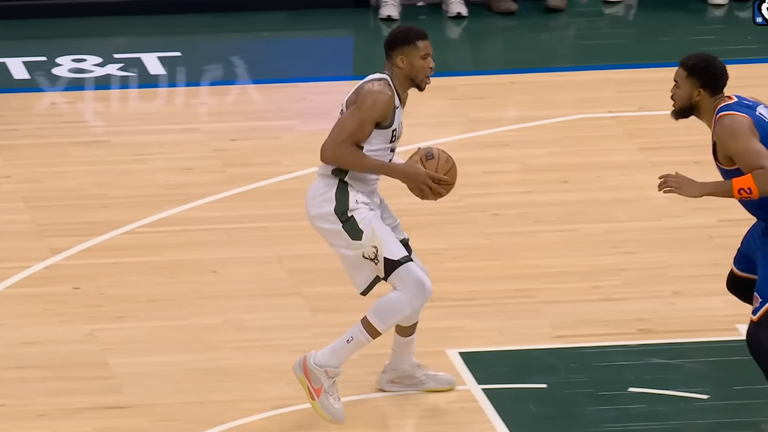
Giannis Antetokounmpo and his “five steps” against the Knicks – we all saw it: he appeared to stroll casually before scoring, after a questionable (but legal) start. A no-call that infuriated everyone – both those in the arena and those watching NBA highlights on social media.
Counting them, Giannis takes five steps before the shot. A sequence that seems to break every rule of the zero step, so debated and disliked by the game’s more “vintage” fans.
And yet, even though everything depends on real-time interpretation by the officials, Antetokounmpo’s move is legitimate under NBA rules. It may look ugly and confusing even after three replays – but it’s correct.
The key lies in the so-called “gather”, the moment when a player gains control of the ball. In Giannis’s case, this happens on his third step, when both hands finally secure the ball. From there, the zero step begins, followed by two legal ones – meaning the basket counts.
The interesting point, however, lies elsewhere. The public (and often even NBA analysts) struggle to translate the gather rule into what they see. The idea of a “gather” is vague: the NBA redefined it in 2019, but it still leaves room for interpretation – especially with players who have huge hands, like Giannis, Wembanyama, or Shai Gilgeous-Alexander.
These athletes can control the ball with just one palm without visibly gripping it, creating visual ambiguity about when the steps actually start. Add their body length and execution speed, and what seems like an obvious travel often isn’t one at all.
Similarly, the zero step has expanded the possibilities for step-backs and side-steps, often seen as illegal by purists but perfectly legal under NBA and FIBA regulations.
On top of that, the league deliberately aims to keep the game flowing, avoiding constant stoppages. Changing the zero-step rule would cause major contradictions, penalizing spins, escape dribbles, and spectacular plays.
The problem is that referee discretion breeds public mistrust, creating a sense of inconsistency. In reality, referees are trained to spot the technical nuances of these moves – even if they often appear passive.
From this stem two widespread beliefs: first, that referees are incompetent; second, that players exploit unclear rules. The truth is, those who master the zero step do so through precision, study, and exceptional body control.
In the NBA, these “counter-logical” moves are routine. Every night we see athletes with an extraordinary mix of technical and athletic ability, capable of operating at the limits of the rulebook with natural ease. In other leagues – where play is more conservative – that creative freedom simply doesn’t exist at the same level.